The aim of this article is simply to document the things I have tried/will try in female strength and conditioning programs which seem to have worked. The evidence base for female athletes is notoriously small and for female AFL there is even less literature due to its relative infancy as a professional code. This article is probably going to evolve as I learn more about coaching especially coaching female teams but it seems like a good place to reflect and record the philosophies that have guided me during the QWAFL season of 2021 and beyond.
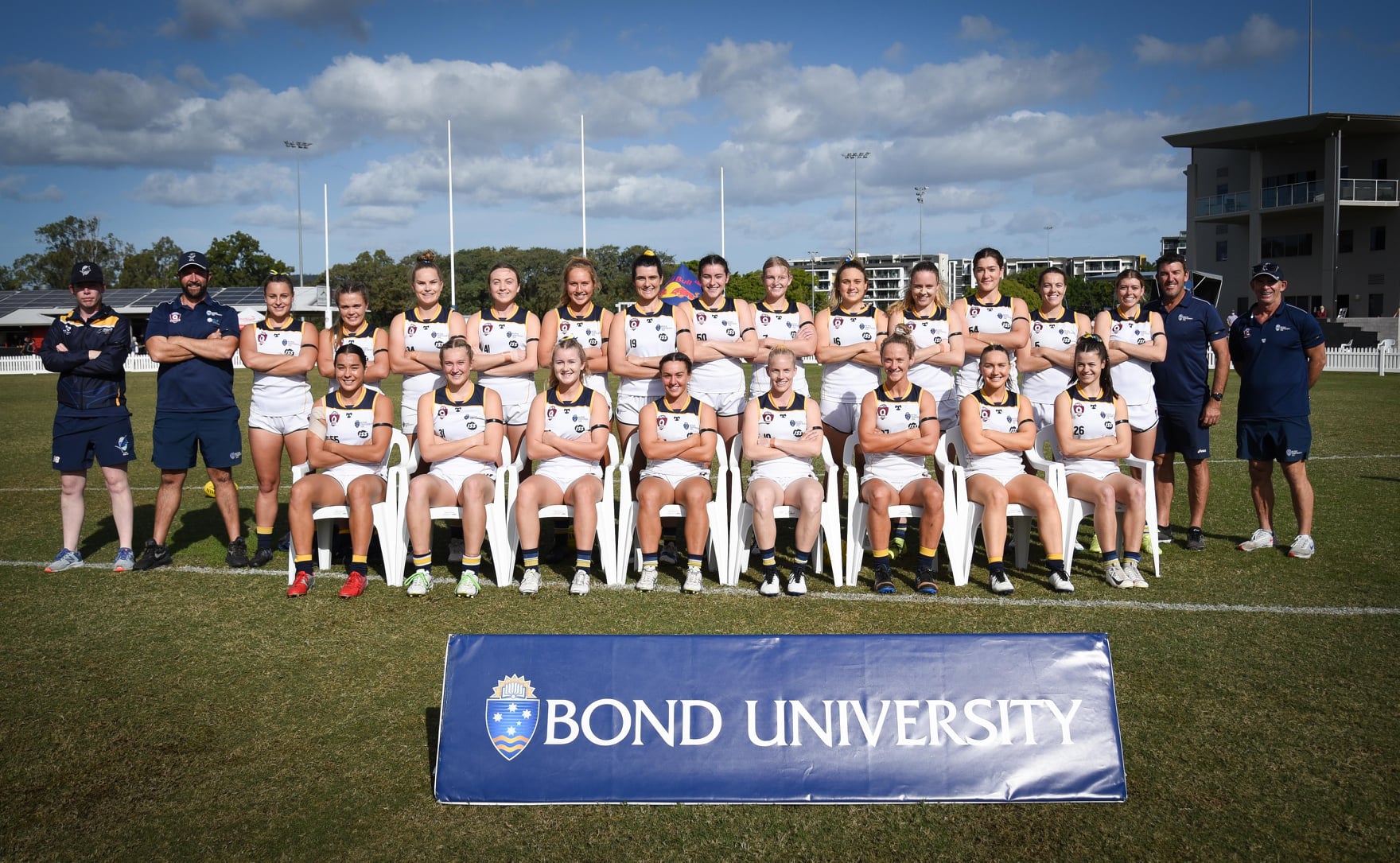
2021 QWAFL – Bond University AFL – QWAFL Development League Premiers, QWAFL Seniors Runner’s Up
Data from the 2020/21 season indicate that we had a total of 65 injuries from ~102 activity exposures (3/wk for 34 weeks [8.5 months]). Relative to player exposure (n = 40/game, 30/training) there was a 2.4% chance of injury to a player during physical activity at the club (65/2720 [8.5 months x 2 training and 17 wks x 1 game]). Therefore, every ~1.5 sessions (~twice a week) someone was injured and individual players can expect to get injured on average once every 43 training sessions (~2 times per year, 1/0.023). Interestingly, when compared to data collected in 2018, the rate of injury during QWAFL 2021 was much lower (15.9/1000 player hours) compared to the 24.8/1000 player hours and 36.9/1000 player hours in the AFLW and AFL respectively (Australian Football League, 2019). To complete the description of our year, knee injuries were the highest frequency (10) followed by hand (8), shoulder (7), ankle (7) and lumbar spine (6). We only had 1 ACL injury and somehow no one injured their hamstring.
Season length and competition demands are probably the missing link between the professional competitions and our amateur competition, though this phenomenon is yet to be investigated between men and women’s competitions and in depth within the women’s competition. Nevertheless, coming into 2021 I expected to lose a girl every week due to injury, to be busy every night rehabbing players and to have little time to watch main training. It seemed that this was what everyone said would happen – all we hear is women get injured more frequently and their injuries are more catastrophic. For the most part, the rehab group has been small and our playing list was almost 100% healthy with some rehabilitation required but not nearly as much as expected. The highlight of the year was when we had a ~3 week period of 0 on our return to run list which was a major milestone for the medical team!
Now I know I may have had a very lucky year and if that’s true, so be it. But I’d like to think that some of the strength and conditioning strategies we maintained year round has helped reduce these injury rates. I’m going to outline them below in the hope that some will resonate with what we put in place in-season and the information may start forming or even firming some philosophies about female team sport/AFL conditioning. At the very least, future Gyan can revisit this article and be reminded or shocked at the strength and conditioning he provided in 2021 and maybe by then he’s managed to connect what he did to some physiology or biomechanical principle.
Consistent Training Volume
Now I know that manipulating training load to reduce injury may not be as powerful as initially thought (see Franco Impellizzeri’s article What Role Do Chronic Workloads Play in the Acute to Chronic Workload Ratio? Time to Dismiss ACWR and Its Underlying Theory | SpringerLink) so I’m not going to call the “ACWR magic” card (sorry to those who were waiting for it) but we did keep volume reasonably consistent during the year and reduced lower leg injuries compared to 2020. It’s a convenient coincidence but meant players were well conditioned to a set of demands by season’s end and this consistency had to have some impact on maintaining steady tissue stress and resynthesis.
We knew (from GPS data collected via the Bond University Sport Science Internship Program) that match loads were approximately 7-8km depending on the player, position, gameplay, weather etc. Using STRAVA data from select players to track volume, we ensured that pre-season training was ~6-7km per night and in-season ranged from 3.5-6km depending on the aim of the particular block and schedule of games. 8 day turnarounds allowed for opportunities to increase load on Thursdays though for most of the year we had a high volume, aerobic based Tuesday and speed training on Thursday. Any extra volume was completed on Monday with Wednesday an allocated resistance training session. Therefore, we knew players would run at least 18km pre-season and between ~15 (3.5 + 4 + 7.5 = 15km) and ~18km (5.5 + 5 + 8 = 18.5) in season. When lockdowns hit (2 including Grand Final Week) we were able to prescribe precise distances for our players to run to maintain the volume of running for their week. Knowing these values allowed us to know whether we were de-loading adequately in season as well. We planned for two low volume, “high fun” phases to ensure the girls had time to recover during high playing density (6 day turnaround) and to introduce variety into our training. If we reached 5km on a deload Tuesday, it meant almost zero volume of conditioning on Thursday to maximise time for skills during the shortened session to get the girls to stay low in volume. Overall, focusing on maintaining volume seems to have reduced spikes in load and excessive overloading of tissues. A gradual increase and decrease occurred at specific points in the season to allow for increased supercompensation or overload depending on the training stimulus required.
| Training Type | Aerobic Volume | Sprints/Agility | Gameday | Totals |
| Day of Week | Tuesday (MD+2/3) | Thursday (MD-2/3) | Saturday/Sunday (MD) | |
| Pre-Season Volume (km) | 6.5-7.0 | 6.0-6.5 | 5.0 | 18.0 |
| In-Season Volume (km) | 3.5-5.5 | 3.5-5.0 | 7.5-8.0 | 18.5 |
Warm Up – Plyometrics for Lower Leg Stiffness
Double foot hops will always be part of my warm ups from now on for the simple reason that I believe it had a moderate impact on lower leg stiffness and knee control during acceleration/deceleration thereby reducing knee injuries. Long bow but hear me out. Lower leg stiffness increases sprint and endurance performance, that we know is clear. Individuals with high volumes of work are at risk from stress-related injuries from high lower leg stiffness so if stress fractures and shin splints have occurred historically this type of work may be contraindicated. Regardless, data on the stiffness of female specific cohorts in the literature and relationships with injury don’t exist but we do know that female athletes have more mobility through the lower leg joints than males (Ward et al., 2019). Therefore if female athletes typically have high mobility through their joints compared to male athletes then introducing stability rather than mobility to joints with common injuries (lower leg) may reduce their mobility during challenging contexts and reduce knee injuries. Of course strength training is the first port of call but plyometrics transfer strength onto the field. We completed descending run throughs with 2 x 5-10 hops for speed and 1 x 5-10 hops for height every session pre-season and in-season. Warm up was an easy place to get reps in of prehab exercises which may help improve performance/reduce injury and because we did it every single session, the reps became easier throughout the year. I also did a fair amount of single leg landing in warm-up without including double leg landing with a mechanics. In my head the ACL mechanism requires range through the joint plus a twist. If we train female players to handle loads through the knee with lower ROM then maybe there is less likelihood of being in a flexed position which quickly turns to valgus? This is a theory which could be risky though it has some biomechanical basis. Maybe a more fleshed out version is to introduce motor patterning in the gym and use the warm up as an opportunity for more explosive plyometrics. Would like to hear if anyone has any opinions on this in case I’m being way too naive.
Warm Up – Chaos Change of Direction
Put simply, we played tag (drop tag to be precise) for half the season in a reasonably small area with a lot of people. Dodging and weaving is an important part of agility and uncontrolled cutting can/will transfer to games in terms of being comfortable and aware of those around you in traffic. The drill inevitably has some clashes as new players/players with poor proprioception run into each other but play it enough and players seem to get better. Plus it’s fun and can be conditioning if you play it for long enough – 2 minutes is a long time going full pelt. The fun element is something to really consider for female sport. Fun is necessary to keep women engaged otherwise the group can get very serious very quickly and on the other side of very serious is very toxic which is dangerous territory for any organisation.
Pre-Season Wrestling
We did some wrestling and tackle/up and sprint work throughout the season to get used to the get up off the ground and contact elements of AFL. From a shoulder injury point of view this may not have worked too well judging by total number of injuries but we didn’t have any catastrophic dislocations or AC joint injuries therefore the severity of injuries may have been reduced. From a contest to contest performance point of view there also seemed to be a little bit of transfer. We prided ourselves on being hard to play against, tackling hard and winning the ball in the contest which we trained for during the early season. By the time we got to mid-season we did peter out with our contested conditioning work during the year as we focused on different things (speed/threshold). Something to consider to continue mid/late season for some variety and to maintain our capacity in the contest.
In-Season Speed
We ran at high speed (sprint/90%) every week once (Thursday) for the entire season bar about 3 weeks. I’d say this was the reason for the lack of hamstring injuries and I’m keeping it for 2022 and beyond. Females don’t tend to get hamstring injuries as frequently as men (AFL, 2019) so the risk is lower though based on 2020 data it does still occur. Performance wise, sprinting all year kept us speedier than the rest of the competition which was our strength. Having an opportunity to run at speed was easy work to implement on the back of warm up and was commonly done in a relay fashion or in partners which means it gets a bit competitive and is always seems a little bit more fun than the long interval work. It also gave girls specific reps and sets to focus on during a conditioning set – they knew if they ran fast and completed it properly then they were able to tick it off and finish the conditioning quickly.
In-Season Conditioning at Threshold
Most long interval work in-season was run at threshold (85% max) on a short time cycle for a number of reasons. Firstly, developing that component of aerobic fitness where lactate can be metabolised helps with the repeat sprint nature of AFL especially for the women’s game where shorter kicks and less players makes it a run and carry game more than a kick and pick our way through a zone game (men’s AFL at the moment). This type of work also gets athletes used to generating high intensity efforts for a long distance when required (see Lily Tarlinton 2nd quarter in the Grand Final for the Development League). Finally, we used it to put distance into their legs in a short period of time – we would boost typical 4.5km sessions to 5.5km with 4 x post to post efforts on the 1:15/1:30 which from a periodisation point of view made it easy to control volume by the inclusion or exclusion of conditioning. These types of efforts can be coached in a number of different ways as well and therefore can be framed in whatever way you’d like to increase the athletes motivation. All in all, much easier to deliver and much better bang for your buck compared to steady state. Ideally we’d have some time to do some fartlek work but footy in hands was the message all year so that type of work had to be completed away from main sessions and were completed on Mondays by those who wanted to.
Summary
Run fast, jump heaps, work hard during intervals and embrace chaos during change of direction work are pillars we stood on this year. For 2022 the challenge will be to build capacity early with a block of high HR/huffing and puffing distance based training and then introduce these in a new way all over again. I guess that’s the challenge of coaching every year, to be better than the previous. Speaking of getting better, any thoughts on inclusions to the program for female specific S+C let me know via comments or messages. Most of this is taking general principles and applying them but I’m sure there are female specific holes performance wise that I’m still not addressing (aside from specificity based on hormonal phase – amateur land is too chaotic to make that happen!). Specifically, in the strength domain we’ll be working on more grip strength work as hand injuries happened way too often this year. Any and all ideas are encouraged to be shared so that everyone (ie. the 4 people who made it this far) can learn from each other! We never know where a little idea can go if enough people are interested.

References:
Australian Football League. (2019). 2019 AFLW Injury Report. Retrieved from https://resources.afl.com.au/afl/document/2019/12/04/125d0f05-e879-4fdd-8851-539abd27310e/2019-AFLW-Injury-Report.pdf
Murphy DF, Connolly DAJ, Beynnon BD (2003) Risk factors for lower extremity injury: a review of the literature British Journal of Sports Medicine; 37(2), 13-29.
Ward, R. E., Fong Yan, A., Orishimo, K. F., Kremenic, I. J., Hagins, M., Liederbach, M., Hiller, C. E., & Pappas, E. (2019). Comparison of lower limb stiffness between male and female dancers and athletes during drop jump landings. Scandinavian Journal of Medicine & Science in Sports, 29(1), 71–81. https://doi.org/10.1111/sms.13309

 Figuring out Sport